FHNW Business Intelligence · 2026
SkinsEdge: CS2 Market Intelligence
A BI platform for the CS2 skin market with live data from three marketplaces, mispricing alerts, price forecasts and AI agents that answer questions.
- Python
- Multi-agent AI
- Forecasting
- MySQL
The idea
CS2 skins trade like a small stock market: thousands of items, several marketplaces and prices that move every day. A rare pattern, float or sticker can make one skin worth many times another with the same name, and the market doesn't always price that in. For the Business Intelligence module I built SkinsEdge, a platform that turns this market into something you can analyse and act on.
What it does
- Live market data from Skinport, CSFloat and the Steam Market, with every price in USD and CHF.
- Mispricing hunters: a sniper alert for discounted listings, float and sticker analysis, and a hidden premium hunter that flags rare patterns listed far below their value. Big finds are pushed to Discord.
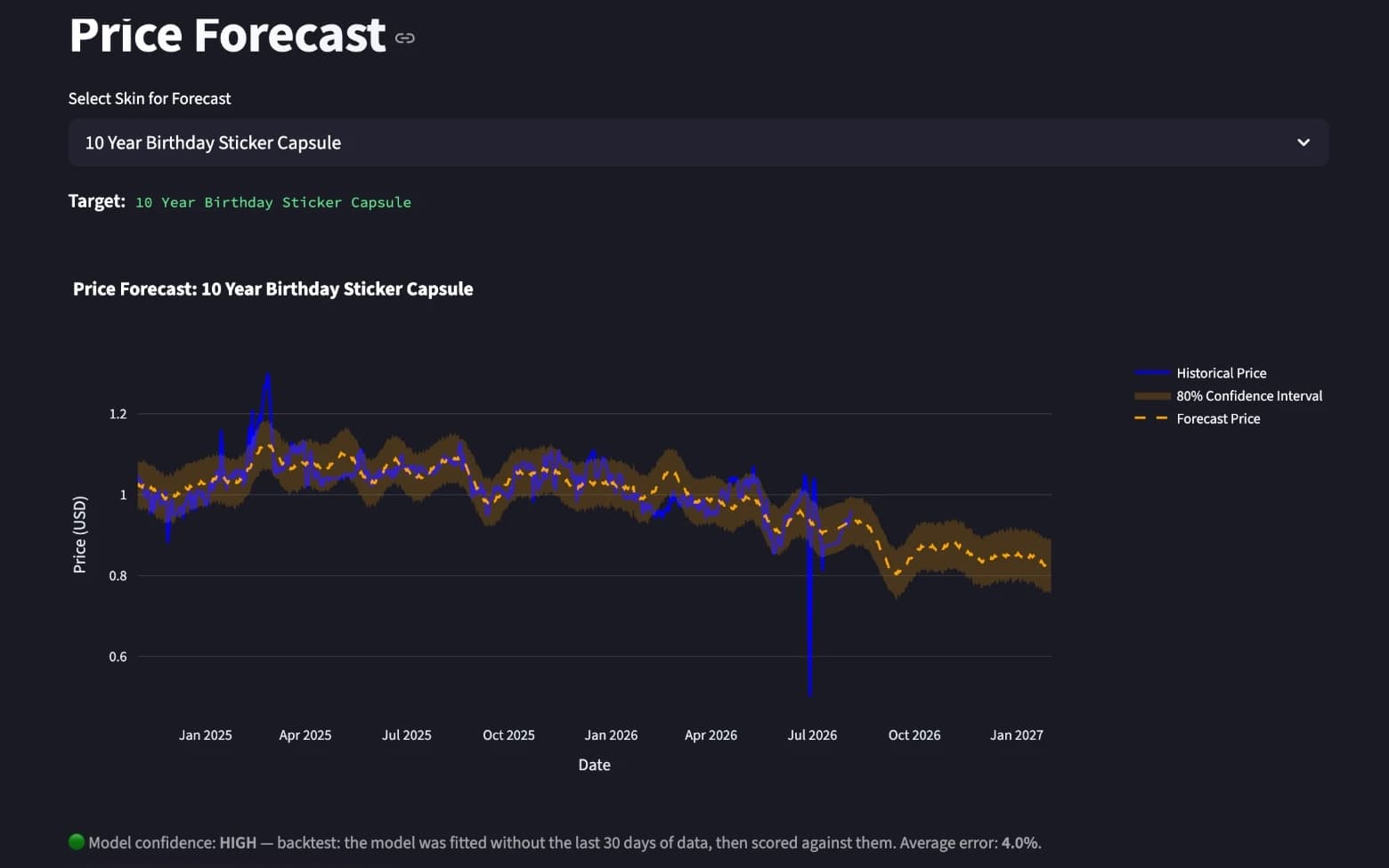
- Price forecasts up to 180 days ahead with an 80% confidence band. Each forecast is backtested on the last 30 days, and its average error sets the confidence label you see in the screenshot.
- A multi-agent system built on Claude: an orchestrator passes questions to research, trading and reviewer agents, which pull real numbers through defined KPI tools and answer in plain language.
- Case analysis, a cross-marketplace comparison and a portfolio tracker.
How it's built
SkinsEdge follows the five-layer BI architecture from the course: data sources, a MySQL data platform, a semantic layer of KPI definitions, an agent and analytics layer, and a Streamlit dashboard plus Discord alerts on top. A scheduler keeps everything fresh, around 130,000 active listings and daily price history for 26,000 items.
Two rules held throughout: no mock data, so every number on screen comes from a live API or a real database row, and the agents never trade. They surface signals, a human decides, and every step they take is written to an audit log.
Built with Python, Streamlit, MySQL, Prophet, Plotly and the Anthropic API.
What I learned
Most of BI is data engineering. One badly designed unique key once filled the price table with 84 million rows, 98% of them duplicates, and fixing it taught me more about databases than any lecture. I also learned how to make agents cite data instead of guessing, and why a forecast without a backtest is just a nice-looking line.